
Energy storage that doesn't burn.
CeraSalt builds stationary solid-electrolyte batteries on sodium-metal-chloride chemistry – for data centres, hospitals, grids and offshore sites where failure is not an option.
Exclusively through AESKA Consulting in the Middle East.
Drag the module to rotate it, scroll to read on.
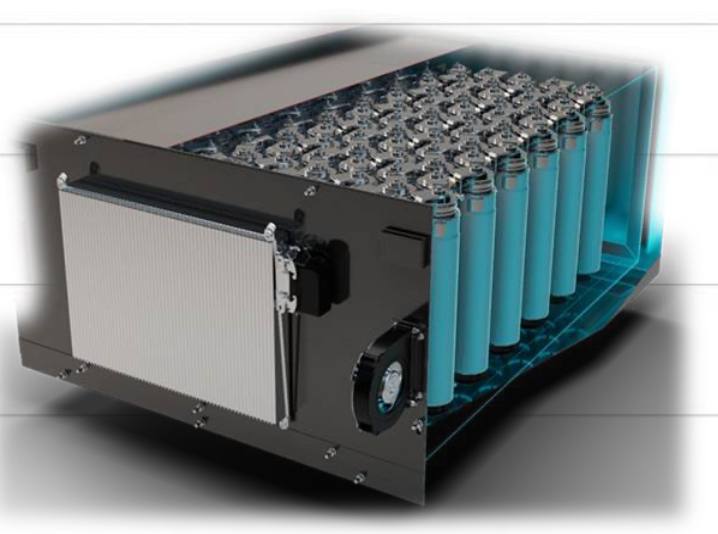
One module. Hermetically sealed.
There are no moving parts inside and no maintenance intervals. The modules run in heat and cold without climate control and can be stacked. Lithium containers, by contrast, need continuous air conditioning in hot environments, which costs space and energy.
At its core: a ceramic cell.
The Gen-4 cell reverses the classic design: anode inside, cathode outside. That makes it larger, more stable and around 70 % cheaper to manufacture than the first cell generation.
- STC 140
- 140 Ah, up to 5 hours of discharge, in production
- STC 250
- 250 Ah, up to 12 hours of discharge, series production from 2027
A solid electrolyte instead of a flammable liquid.
Between the electrodes sits a tube of beta-alumina ceramic. It lets sodium ions pass but blocks electrons – and there is nothing inside the cell that can ignite.
If a cell fails, the string keeps running.
When a CeraSalt cell fails it becomes conductive (sub-ohmic) and the string stays in operation. With lead-acid, nickel-cadmium and lithium, the entire string fails instead – critical loads therefore need a second, complete system.
Annual failure rates incl. replacement, mobile networks in South Africa, reports since 2014.
Stacked: 800 volts from three modules.
Without fire-safety spacing, more power fits on less floor space – in data centres, metro stations or on platforms.
- 20+ years
- service life without capacity loss
- 3×
- peak power relative to rated power
- > 90 %
- usable depth of discharge
- 1.25 ct
- per kW and standby hour, incl. acquisition
Figures according to the CeraSalt company presentation 2026.
Your project, directly at management level.
AESKA Consulting supports CeraSalt projects from the first application analysis through to implementation – across the Middle East.
AESKA Consulting · Mainzer Landstraße 109 · 60329 Frankfurt am Main · Legal notice · Privacy