No double fire risk
The beta-alumina solid electrolyte works without flammable liquid or pasty electrolytes. Neither self-ignition nor ignition by external impact — and no insurance surcharge.
 Exclusively through AESKA in the Middle East
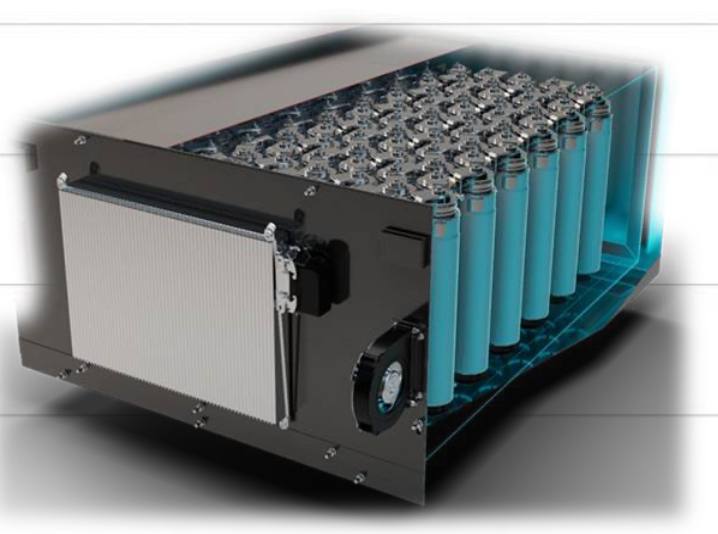
Not every battery belongs in critical infrastructure.
Stationary solid-electrolyte batteries built on sodium-metal-chloride chemistry (SMC / NaNiCl). Non fire-prone, maintenance-free, no capacity degradation — from a fully European value chain.
CeraSalt® is a brand of CeraSalt GmbH, Redwitz a.d. Rodach — a spin-off of Alumina Systems GmbH.
Why CeraSalt?
The beta-alumina solid electrolyte works without flammable liquid or pasty electrolytes. Neither self-ignition nor ignition by external impact — and no insurance surcharge.
Stable chemistry and hermetic sealing keep capacity constant across the service life. No moving parts, no maintenance visits, zero self-discharge at rest.
Cells run thermoneutrally at 270–330 °C, using their own process heat. No climate control — in hot or cold regions alike.
Rock salt from Swiss mines, carbonyl nickel from Wales, iron and steel from Germany and Sweden. Cell production, module assembly and BMS development in Europe.
Assembly
Keep scrolling — the module takes itself apart and puts itself back together.
A hermetically sealed industrial build with no moving parts inside. It carries the cells, guides the heat and needs no service intervention across its entire service life.
The heat exchanger sits at the front face. In normal operation the module runs thermoneutrally at 270–330 °C on its own process heat — only the power electronics are cooled, never the cell.
Upright Gen-4 cylindrical cells in AICO design. If a cell fails it turns conductive and the string stays live, which is why simple redundancy replaces a second system.
Inside every cell a beta-alumina cylinder separates anode and cathode. It conducts sodium ions, blocks electrons — and contains nothing flammable.
Stacked and scaled this becomes a battery delivering 800 V from three modules, discharging over five to twelve hours and running 20 years without capacity loss.
CeraSalt in comparison
LFP and sodium-ion cells use liquid or pasty electrolytes and therefore carry a double fire risk: self-ignition and external-impact ignition. CeraSalt relies solely on alumina ceramics as a solid electrolyte.
Annual failure rates in the field
Remotely monitored UPS batteries in South African mobile networks; annual failure rates incl. replacement, operator reports since 2014.
Figures from the CeraSalt investor pitch deck and the sources cited there. The bars rate suitability for safety-critical stationary use — not energy density, where LFP is 20–40 % higher, an advantage that redundancy, climate control and separation distances largely offset at system level.
Product portfolio
The fourth-generation AICO architecture allows different cell types on the same electrolyte. A hybrid battery combines continuous power, peak load and UPS duty — up to three times rated power, several times a day.
Critical Power
Power-optimised Gen-4 cell for UPS, peak shaving and high power demands.
Status: Development completed, in production
Long Duration Storage
Energy-optimised cell for PV storage and long discharge times at lower power.
Status: In development and testing, SOP 2027
Supra Power
Planar cell for emergency power and extreme short-duration peaks.
Status: Concept in the product pipeline
Technical comparison
| Parameter | Gen-1 cloverleaf | Gen-2 (IKTS) | CeraSalt STC 140 | CeraSalt STC 250 |
|---|---|---|---|---|
| Capacity | 38 Ah | 100 Ah | 140 Ah | 250 Ah |
| Discharge duration (100 %) | 4 h | 5 h | 5 h | 12 h |
| Max. discharge current (1 min) | 60 A | 45 A | 100 A | 100 A |
| Cells per kWh | 12 | 4.5 | 3 | 1.6 |
| Max. depth of discharge | 80 % | 80 % | > 90 % | > 90 % |
| Production cost (indexed) | 1.0 | 0.90 | 0.5 | 0.3 |
Compared with the first-generation cloverleaf cell, the Gen-4 cell achieves roughly 70 % lower production cost. Open circuit voltage is 2.58 V in each case.
Total cost
Acquisition and running operation combined. Lower redundancy, longer life and no climate control push total cost well below established UPS chemistries.
Applications
From UPS in nuclear power plants to offshore platforms and AI data centres: wherever safety is non-negotiable and lithium is sometimes not permitted at all.
800 V DC from a stack of three modules, N redundancy and 24/7 operation.
Remotely monitored UPS across distributed sites — proven in the field for over 30 years with the lowest failure rates of any established chemistry.
Backup power in buildings and plants where a thermal event must be ruled out — including UPS in nuclear power stations.
Storing renewable generation with 5 to 12 hours of discharge, including hot or exposed sites.
Energy management on platforms and vessels: low maintenance intensity, over 15 years of service, no insurance premium.
Hybrid backup systems with 5 to 12 hours of discharge, combinable with hydrogen via the HyHeat® concept.
Recovering braking energy underground, where flammable storage is ruled out by building codes.
Radar and laser systems, fleet charging infrastructure, operation at extreme temperatures and in remote locations.
Background
CeraSalt is a spin-off of Alumina Systems GmbH in Redwitz an der Rodach, a specialist in ceramic-to-metal bonding originating from a former Siemens division. Battery development started in 2018 and has been funded through the European IPCEI programme.
Reach
AESKA Consulting connects this Upper Franconian technology with operators and investors along the Europe–Middle East axis. Hot regions are where CeraSalt plays its strongest hand: no climate control, no heat-driven degradation.
Documents
Why AESKA Consulting?
AESKA Consulting connects European deep technology with international markets and supports companies from first project analysis to strategic delivery.
Direct access
AESKA Consulting works directly with the management of CeraSalt GmbH. Enquiries therefore do not pass through several intermediaries but reach the decision-makers in Redwitz directly — from initial technical consulting to the design of a concrete project.

In direct coordination with Dr Roland Egerer, Managing Director of CeraSalt GmbH.
Request a projectProject process
How AESKA takes CeraSalt projects in the Middle East from idea to implementation.
Request a CeraSalt project now
For investors, operators and industrial companies. We usually reply within two working days.
Mainzer Landstr. 109
60329 Frankfurt am Main
Frequently asked
The heat sits inside a hermetically sealed, insulated cell whose surface stays lukewarm. Unlike lithium there is no chain reaction: the solid electrolyte contains nothing flammable, so thermal runaway is ruled out. In normal operation the battery holds its temperature thermoneutrally from its own process heat.
Anode-Inside / Cathode-Outside: compared with the classic cloverleaf cell, anode and cathode swap places and the geometry is redesigned. The result is larger cells with more than 90 % depth of discharge, around 70 % lower production cost and far fewer cells per kilowatt hour.
It becomes low-resistance conductive and current keeps flowing through the string. The battery stays online and no second reserve system is needed. This fail-operational behaviour is what cuts investment cost and footprint against 2N designs using lead, NiCd or LFP.
The STC 140 for critical power is developed and in production. The STC 250 for long discharge times is in development and testing, with start of production in 2027. The planar SPC 40 for extreme peaks is a concept in the product pipeline.
We first clarify duty profile, site, power profile and timeline. Initial technical consulting follows, then the documents, and — where there is a fit — a direct introduction to CeraSalt and to the right industrial and investment partners.
As a solid-electrolyte battery and stationary energy storage system (BESS), CeraSalt addresses requirements that increasingly shape data center UPS applications, grid expansion and Middle East energy solutions: fire safety, temperature tolerance, low total cost and a resilient European supply chain. AESKA Consulting supports operators and investors in evaluating, structuring and delivering such projects — a critical infrastructure battery for sites where security of supply is business critical.

Frankfurt am Main · Dubai · Riyadh · London · Istanbul
Request a project